Today, let’s discuss the market correction a bit:
It has been almost 2 years now with no significant returns in the market, and a lot of articles are highlighting this exact issue. Let’s discuss this because this correction has been majorly painful for people not due to a price correction, but primarily due to a time correction.In a typical market crash—like the one we saw during COVID-19—amidst various issues, the market fell 38% within a single month and then recovered.
After COVID, we saw a massive new investors came into the market. We’ve seen how stocks like BSE and CDSL skyrocketed, showing how market participation has exploded with so many new investors entering the space. For these new investors, specifically the post-COVID investors, this is their first time experiencing this kind of painful phase. I would call it a ‘painful’ but slow pain. It is not a very severe, sudden pain all at once; rather, it is a slow, lingering pain.
So, given this ongoing slow pain, what should be done going forward On top of that, SIP investors are also having their patience tested right now. Let’s try to analyze this. Okay, so it has been 725 days since the Sensex hit its peak on 26th September 2024. From that peak until now, this has been an incredibly long stretch. In fact, it is the longest stretch since 2012, because a very similar phase occurred between 2010 and 2013.
Now, we are seeing that kind of phase repeat itself.And thanks to Mr. Trump, it feels like this uncertainty is going to continue for a bit longer. Specifically, now that central banks have started hiking interest rates, these factors could drag this phase out even further—at least, that is what predictions are suggesting.
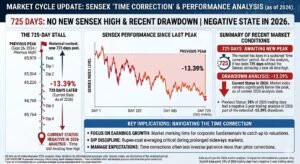
We have already seen that the Sensex is more than 10% down from its all-time high levels. Moreover, 38% of the trading days in ’26 are showing negative 2-year returns. So, that doesn’t exactly feel like a very motivating factor either.Now, let’s look back at history a bit to see how previous corrections played out and how the subsequent recoveries happened. For instance, if we talk about 2020, we witnessed a 38% fall in the market. That fall lasted for about 2 months—it was a very sharp crash because the COVID-19 uncertainty was so massive. But how many months did it actually take to recover.So, the 38% fall happened within 2 months. After that, it fully recovered within 8 months.
This means the market returned to the same level in 10 months. If we talk about 2008, there was a 61% fall. How much? A 61% fall from the peak to the lowest point. And this fall lasted for more than a year. Meaning, it happened gradually over time. Uh, so, and how much time did it take to recover? It took 20 months for the recovery. How much? It took 20 months to recover. So, almost, if we add both these numbers, it took around 33 or 34 months for the market to return to its previous peak. Then, if we talk about 1994, the market fell 41% from the peak. But it took 27 months for this fall to happen. So, this means there was both a price correction and a time correction. And after that, how much time did it take to recover? It took 31 months. Meaning, 27 + 31, so it was almost a 5-year ‘no returns zone’. If we look at the 2000 fall, there was a 56% fall in 2000 from the peak to the bottom. And this fall happened over 19 months. Meaning, the market kept falling gradually.”
You are not here to predict that it will happen the exact same way again or that these will be the exact same numbers. But what we are trying to suggest over here is that all these things have happened in the market before. And that is the reason why we say that if you want to invest in equity markets, why your investment horizon should be five plus years. And specifically, if you are making regular savings, why should those savings go into the market in a staggered manner as SIPs? Because during such times—these phases, meaning the phases of price and time correction that lasted between one to five years or three to five years—the people who made acquisitions during these periods went on to generate very good returns.”